

If you're reading this, you've likely tried the standard run-of-the-mill toothbrushing advice repeatedly. While traditional advice helps a large subset of the population, suggestions like “make it fun!” or “use a timer!” may not be effective if your child finds the sensation of bristles on their teeth overwhelming, or if the bathroom lighting triggers sensory overload.
The standard advice doesn’t work, but it’s important to know that you're not failing. Not even in the slightest. The advice just wasn't written for your situation.
This guide offers practical strategies developed by working with families like yours. It's not a step-by-step manual because there isn't one approach that works for every child. Instead, it's a collection of adaptations and alternatives. Choose what works for you and disregard what doesn’t. Remember, progress is more important than perfection, and you are already doing more than you might realise.
You Know Your Child Best

If you are a parent of a child with additional needs, it can be reassuring to acknowledge that standard oral health advice was not created with your family's circumstances in mind.
Your child may have sensory sensitivities that make toothpaste unbearable or find the sound of an electric toothbrush overwhelming. Dental visits may be genuinely distressing rather than just mildly unpleasant, and daily brushing could feel like a battle that leaves you exhausted.
It’s essential to recognise that this does not reflect a failure in parenting.
Oral health is crucial for all children, but those with additional needs often face higher risks. They may be more likely to require dental treatment under general anaesthesia, and dietary factors or medications can impact their dental health. Additionally, dental issues can be particularly distressing for children who have difficulty communicating when something hurts.
The advice in this guide provides a toolkit of different approaches. Not everything will work for every child, so trust your instincts—you know your child best and are in the best position to determine what may help them.
Remember, the goal is progress, not perfection. Even small steps forward can build your child's confidence and your patience over time.
Understanding the Challenges
Why mouth care can be difficult
- Sensory sensitivities: Some children may find the textures of toothpaste, the feel of toothbrush bristles, the taste of mint, the noise from an electric toothbrush, and the sensations around their mouth and face overwhelming.
- Need for predictability: Changes in routines can be distressing. For instance, using a new toothbrush or different toothpaste can disrupt an established mouth care routine.
- Communication differences: Your child may struggle to understand why brushing is important or to express discomfort or pain during the process.
- Physical challenges: Motor control, positioning, fatigue, and reflexes can make brushing difficult or even impossible without assistance.
- Anxiety: Negative past experiences, fear of the unknown, or general anxiety can make mouth care seem intimidating.
- Sensory overload in dental settings: Bright lights, clinical odours, unfamiliar sounds, and strangers touching patients' faces can create overwhelming situations.
The basics still apply
The fundamental principles of oral health remain unchanged:
- Use fluoride toothpaste. Many children benefit from 1,350–1,500ppm fluoride,
but some may need lower strengths depending on tolerance and swallowing.
Your dentist can advise on the most appropriate option for your child.² - Brush twice daily to remove plaque.
- Limit the frequency of sugary foods and drinks to reduce the risk of decay.
- Schedule regular dental check-ups to identify problems early.
But HOW these are achieved may look very different for your child.
Making It Work

The following toolkit can be adjusted to fit your child's needs. Take what is useful and leave what isn't.
Adapting the environment
Reduce sensory input:
- Dim the lights if possible.
- Choose a quiet space with no background noise or music.
- Some children may be more comfortable outside the bathroom, which can be echoey, bright, and cold.
Keep it predictable:
- Use the same place, time, and sequence for brushing every time.
- Have everything ready before you start.
- Use the same words and actions consistently.
Trying different equipment
Toothbrushes:
- Soft bristles may be more comfortable than medium bristles.
- Smaller heads can reach more easily and feel less intrusive.
- Electric toothbrushes work well for some children, while others may dislike the vibration.
- Finger brushes can help with desensitisation and tolerance building, though
they are less effective than toothbrushes for plaque removal. - Three-sided brushes may help some children tolerate brushing by reducing
the number of movements required.
Toothpaste:
- Unflavored toothpaste is available if mint is intolerable.
- Gel textures feel different from paste.
- Start with tiny amounts and gradually increase the quantity.
- Aim for 1450 ppm fluoride, but remember, any brushing is better than none.
Finding the right position
Whatever position works best for your child is the right one:
- Standing, sitting, or lying down.
- On your lap, between your knees, or in front of a mirror.
- In the bath or shower, if that feels calmer.
- Lying with their head on your lap provides good visibility and control.
For children who need physical support, consider the positions you use for other care routines. Some children may benefit from brushing their own teeth with your hand-over-hand guidance.
Timing
- Incorporate brushing into existing routines when possible.
- Some children handle brushing better at certain times of the day.
- If brushing twice daily is currently impossible, doing it once is still beneficial.
- Start with brief brushing sessions and gradually increase the duration.
- A timer can help, but only if it doesn't add pressure.
Building tolerance gradually
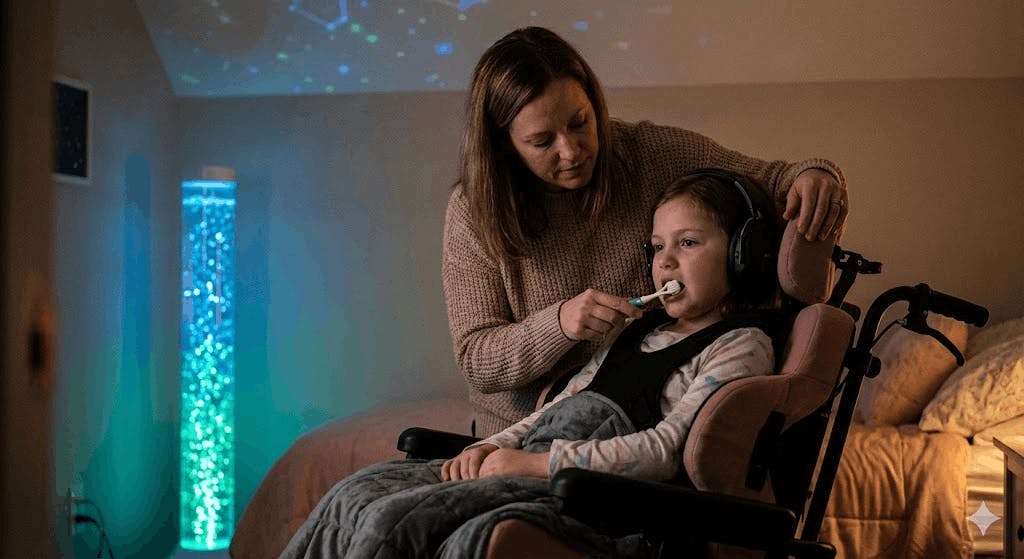
If your child currently cannot tolerate tooth brushing at all, you may need to implement small, gradual steps:
- Place the toothbrush in the room (that’s it).
- Let the child hold the toothbrush.
- Have the toothbrush touch their lips.
- Allow the toothbrush to touch their teeth without actual brushing.
- Conduct brief brushing sessions lasting just a few seconds.
Gradually increase the duration over time. Remember, each small step is progress, and patience will help your child adapt at their own pace.
Visual supports
Many children respond positively to visual information. Consider using the following tools:
- Visual Schedules: Create schedules that illustrate each step of brushing with simple pictures.
- Social Stories: Write stories that explain what will happen during tooth brushing and why it is important.
- Now/Next Boards: Use these to clarify the sequence of activities.
- Visual Timers: Sand timers can visually show how much time is left for brushing.
- Videos: Share videos of other children brushing their teeth (BSPD has some resources available).3
Rewards and motivation
Immediate and predictable rewards tend to be the most effective. Here are some ideas:
- Allow a preferred activity straight after brushing
- Implement sticker charts for motivation.
Keep the experience positive and avoid punishing your child for non-compliance, as this often makes the situation worse.
Understanding resistance
When your child resists brushing, they are often communicating a specific concern:
- Sensory overload: Consider reducing sensory input or trying different equipment.
- Unpredictability: Increase structure in the routine and use visual supports.
- Past negative experience: Take it slowly to rebuild trust.
- Something hurts: Check for sore gums, ulcers, or tooth pain.
- Need for control: Offer choices within the brushing routine to empower your child.
What doesn't help
Avoid the following approaches, as they are generally ineffective:
- Forcing or restraining your child (except in genuine safety emergencies).
- Rushing through the process.
- Displaying frustration (it's natural to feel frustrated, but it's crucial to manage it).
- Giving up entirely.
When it's really difficult
Some days will be worse than others. That's normal.
A quick brush is better than a battle that leaves everyone distressed. Rinsing with water is better than nothing. Tomorrow is another day.
If you're consistently struggling, consult your dentist. They may suggest alternative approaches, refer you to specialists with more experience, or offer different treatment options.
Preparing for Dental Visits

Preparing for dental visits can be a challenging experience for both children and parents. This section offers practical strategies to help ease the process and ensure a positive outcome.
Before the visit
Try modelling first: Consider taking your child along to your own dental appointment or a sibling's appointment. This will help them see what happens in a calm, pressure-free environment.
Build familiarity gradually: Help your child get used to the dental environment by gradually exposing them to it. Even sitting in the waiting room or walking past the practice can be beneficial.
Choose appointment times wisely: Request an appointment for either the first or last time of the day, when the waiting room is likely to be quieter.
Use Preparation Tools: Prepare your child using social stories, photos from the practice's website, or videos about what to expect.
Bring Comfort Items: Consider bringing items that provide comfort, such as fidget toys, ear defenders, sunglasses, or other favourite comfort items.
Share Your Child's Needs in Advance: Communicate your child's specific needs by calling or emailing the dental practice before the appointment.
What you can ask for
Dental practices are expected to make reasonable adjustments for children with additional needs, in line with NHS England clinical standards and equality legislation.¹ You can ask for the following accommodations:
- Longer appointment times
- The option to wait in the car until your child is ready
- Dimmed lights in the treatment room
- Explanations before each step of the procedure
- Breaks during the examination if needed
- The same dentist for each visit
- Desensitisation visits where the child only sits in the chair without any procedures taking place
During the visit
- You are allowed to stay with your child throughout the appointment.
- It’s perfectly okay to stop the visit if your child becomes distressed.
- Communicate with the dentist about what works well for your child and what doesn’t.
- Remember, even a partial examination is better than no examination at all.
If it doesn't go well
One challenging visit does not mean that every visit will be difficult. Discuss with your dentist about what could help next time. If the current dental practice can’t accommodate your child’s needs, ask about other options. Your dentist can guide you on the available services in your area.
Progress, Not Perfection
For some families, taking care of mouth care can be more challenging than for others. This is not a failure; it is simply a reality.
The goal is to find an approach that works well enough, often enough, to protect your child's teeth and keep them comfortable. What this looks like will vary for each family.
Every small step forward is significant. For example, a child who once couldn't tolerate a toothbrush near their face but now accepts brief brushing has made real progress. Additionally, a family that has found a dental team that understands their child's needs has removed a major barrier.
You are doing something difficult. Managing your child's oral health alongside everything else in your life requires persistence and patience. If today was tough, remember that tomorrow is a new day.
If you are struggling, your dentist can help you explore options and, if necessary, connect you with services that have more specialised experience. You don’t have to navigate this alone.
Quick Reference
When to Get Help
Signs of dental problems
Children with additional needs may show dental pain differently. Watch for:
- Face rubbing or holding their cheek
- Changes in eating (refusing food, only eating on one side)
- Behaviour changes (increased distress, sleep problems)
- Visible decay (brown or black spots on teeth)
- Swelling of the face or gums
- Bleeding gums
- Broken or damaged teeth
When to seek support
- Unable to brush at all despite trying different approaches
- Dental visits are consistently impossible
- Your child needs treatment, but can't tolerate it
- Your current dentist isn't able to meet your child's needs
Talk to your dentist first. They can advise on approaches, alternative treatments, and what services might be available locally.
Your GP or health visitor can also help with referrals if needed.
Urgent dental problems
- Severe pain or swelling: Contact your dentist urgently or call NHS 111
- Knocked-out or broken tooth: This is a dental emergency; seek immediate care
- Signs of dental abscess (swelling, fever, difficulty swallowing): Contact your dentist urgently or NHS 111. Seek emergency medical care if there are breathing or swallowing difficulties


