

You have been given the opportunity to work with with Gypsy, Roma, and Traveller families on oral health. You’ve looked at the data and noticed a troubling trend of higher rates of dental decay and lower attendance at dental appointments, which fuels your desire to make a positive impact.
However, past experiences have left many GRT families feeling let down by health services. For instance, a mother may hesitate to bring her children to the dentist after experiencing dismissive behaviour from the receptionist during a previous visit. Your health session might have no attendees because families associate engaging with services with judgment and unwanted interference.
Trust has been compromised, and understanding its importance highlights that restoring it requires time and effort.
If you find yourself uncertain about how to re-establish trust with families who have valid reasons for scepticism, how to provide support without pushing your own agenda, or how to engage respectfully with communities that value their independence, this guide is tailored for you.
Why Trust Matters
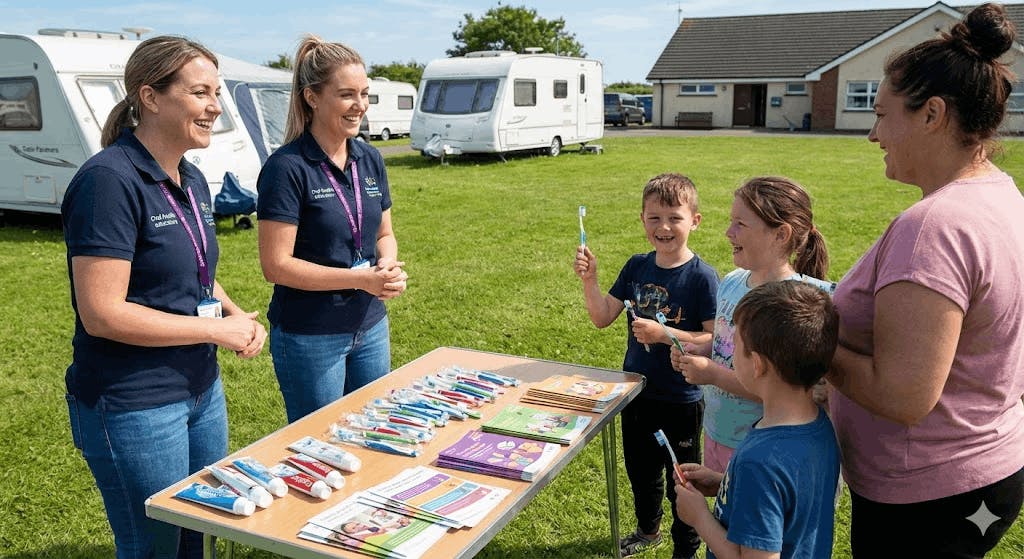
Gypsy, Roma, and Traveller (GRT) communities in the UK experience some of the poorest health outcomes, and oral health inequalities are well-documented.² Yet these same communities often have the lowest engagement with health services.
This isn't because families don't care about health. It's because services have repeatedly let them down.
GRT communities have experienced generations of discrimination, forced evictions, and exclusion from mainstream services. Many families have had negative encounters with health professionals who made assumptions, broke confidentiality, or treated them disrespectfully. This history understandably leads to caution when engaging with health services.
If you want to support oral health in GRT communities, you must start with trust. Without trust, even the best information and services will be rejected. With trust, you can make a real difference to families' health and wellbeing.
Your role is not to enforce health messages; it is to build relationships, understand what matters to families, and offer support that respects their values and way of life.
Understanding Community Context
Diversity Within GRT Communities
"GRT communities" is a shorthand that covers many distinct groups, each with its own history, culture, and traditions.
Romany Gypsies have been in Britain for over 500 years. They're a legally recognised ethnic group with their own language (Romani) and cultural traditions.
Irish Travellers are a distinct ethnic group with roots in Ireland, who speak their own language (Shelta/Cant). They have a strong presence throughout the UK.
Scottish Travellers have their own distinct identity and traditions, particularly in rural Scotland.
Roma people have migrated to the UK more recently, primarily from Central and Eastern Europe, and they face specific challenges related to language and documentation.
Showmen and Fairground families travel for work, following fairs and events. They have their own community structures and traditions.
Boat dwellers and New Travellers have chosen a mobile lifestyle for various reasons and may not share the same ethnic or cultural background.
It is important to recognise that these groups are not interchangeable. Respecting their differences and taking the time to ask, listen, and learn from the specific families you are working with will help them feel valued and understood.
Shared Values
Despite their diversity, many GRT (Gypsy, Roma, and Traveller) communities share specific values that influence how they interact with services.
- Family is central. Extended family networks are strong in these communities. Decisions about health often involve the whole family, not just parents. Elders hold significant influence in these discussions.
- Independence and self-reliance. Many families prefer to manage their own affairs without outside interference. Seeking help from services can feel uncomfortable or be perceived as a sign of weakness.
- Oral tradition. Information is typically shared through conversation rather than written materials. Therefore, leaflets and forms may be less effective than face-to-face discussions.
- Privacy and boundaries. There is often a clear distinction between family/community matters and interactions with outsiders. Trust must be established before families feel comfortable sharing personal information.
- Practical priorities. When families face challenges such as housing insecurity, financial pressures, or discrimination, dental care may not be their top concern. This prioritisation is a rational response to difficult circumstances.
Why Services Have Failed
Many GRT families have good reasons to distrust health services.
- Being turned away from practices or told there are no appointments
- Experiencing judgment or discrimination from staff
- Having confidentiality broken when information was shared inappropriately
- Being asked intrusive questions unrelated to health
- Feeling that services are designed for settled communities and don't accommodate their needs
- Previous involvement with services leading to unwanted intervention in family life
Understanding this history helps you approach families with humility rather than frustration when engagement is slow.
Practical Engagement Approaches

Build Relationships First
Don't lead with health messages. Lead with relationship.
If you're new to a site or community, take time to introduce yourself. Explain who you are, what you do, and why you're there. Be honest about your role. Answer questions openly.
Be consistently present. One-time visits do not establish trust. Regular and reliable contact demonstrates your commitment.⁴ If you say you will return on Tuesday, make sure to do so.
Discover what matters to families. Ask about their lives, concerns, and priorities. Oral health may not be their top priority, and that’s perfectly okay. Show that you care about them as individuals, not just as targets for health messages.
Work with Community Gatekeepers
In many Gypsy, Roma, and Traveller (GRT) communities, certain individuals, such as elders, community leaders, or respected family members, hold influence, and their endorsement can help open doors or limit engagement.
If there is a Traveller liaison officer, site manager, or community development worker trusted by families, collaborate with them. Request introductions and respect their knowledge of the community.
Be patient. Building relationships with gatekeepers takes time, so do not expect immediate access to families.
Communication That Works
- Talk, don't write. Engage in conversation rather than relying on written communication. Face-to-face discussions are usually more effective than leaflets or letters. If you must share written information, walk through it verbally as well.
- Use plain English. Avoid jargon and complicated explanations. Be clear and direct.
- Visual aids help. Pictures, diagrams, and demonstrations can communicate more effectively than words, especially for families with lower literacy levels.
- Respect oral culture. Information shared by trusted community members carries more weight than information from outsiders. This is why strategies like training community Oral Health Advocates have been successful. For example, the Sussex collaborative programme demonstrated that training a trusted community member to share oral health messages was far more effective than having outside professionals deliver the same information.¹
Avoid Common Mistakes
Don't make assumptions. Not all Traveller families are the same; their needs, beliefs, and circumstances may vary. Always ask rather than assume.
Don't be patronising. Families have a better understanding of their own lives than you do. Provide information and support rather than delivering lectures.
Don't push too hard. If a family is not interested in engaging with dental care at the moment, respect their decision. Leave the door open for future conversations.
Don't break confidentiality. GRT communities are often close-knit, and information can spread quickly. Be very careful about maintaining confidentiality, as families who fear their information may be shared inappropriately are less likely to engage.
Don't take rejection personally. If families are cautious or dismissive, it reflects their past experiences, not your worth. Stay professional, respectful, and available.
When Families Are Not Interested
Not every family will want your support, and that's their right.
If a family declines engagement, thank them for their time and leave the door open for future conversations. You might say something like, "That's fine. If you ever want to discuss anything, I'm usually here on Tuesdays."
Don't keep pushing. Don't make families feel they're being targeted or monitored. Respect their autonomy.
Sometimes circumstances change. A child may develop a toothache, or a family member may have a dental emergency. If you have been respectful and consistent, they may reach out when they need help.
Making Progress Over Time
Small Wins Matter
Trust builds slowly, and progress may feel incremental. It can start with one successful conversation, a family agreeing to register with a dentist, or a child attending a check-up.
These small wins are important. They help establish your reputation and show other families that engaging with you is safe.
In GRT (Gypsy, Roma, and Traveller) communities, word spreads quickly. If you help one family effectively, others will hear about it. Conversely, if you let one family down, that news will also travel.
Families Talking to Families
The most effective oral health promotion comes from within communities rather than from external professionals.
When families have positive experiences, they are likely to share them. For example, a mother who took her children to the dentist and had a good experience will inform other mothers. In contrast, a grandmother who successfully managed her dentures can reassure others of its value.
Your role is to facilitate these positive experiences. The community will do the rest.
Long-Term Relationships
Meaningful change takes years, not weeks. If your organisation is genuinely committed to supporting GRT communities, it must focus on long-term engagement.
Short-term projects that abruptly appear and then vanish can do more harm than good, reinforcing the belief that services are unreliable.
It’s essential to build relationships that extend beyond individual projects. If you are leaving your role, introduce your successor to families to ensure continuity whenever possible.
When to Step Back
Sometimes, the kindest action is to step back. If a family has clearly expressed a desire not to engage, it’s important to respect that. If your presence is creating tension or problems, consider whether you are genuinely helping.
Stepping back doesn’t mean giving up; it means respecting boundaries and waiting for a more appropriate moment.
Celebrating Community-Led Success
The most sustainable improvements occur when communities take the lead in their health promotion efforts.³
Some areas have successfully trained GRT community members as Oral Health Advocates, who then share messages within their own networks. This approach, developed through initiatives like the Sussex Collaborative, exemplifies what can be achieved when communities are empowered rather than targeted.
Your role may involve supporting, resourcing, and enabling community-led approaches instead of delivering messages yourself.
Quick Reference
Key principles:
- Trust first, health messages second
- Relationships are built over time through consistent, reliable contact
- Diversity exists within GRT communities. Ask, don't assume.
- Respect family autonomy and decision-making
- Work with community gatekeepers and trusted individuals
Effective approaches:
- Face-to-face conversation over written materials
- Plain English, visual aids, demonstration
- Regular presence, not one-off visits
- Honesty about your role and purpose
- Scrupulous confidentiality
Avoid:
- Assumptions and stereotypes
- Patronising or lecturing
- Pushing when families decline
- Breaking confidentiality
- Taking rejection personally
When families are not interested:
- Thank them, leave the door open
- Remain available for when circumstances change
- Don't keep pushing
- Respect their autonomy
When to Get Help
Contact dental services if a family reports:
- Toothache or dental pain
- Visible decay in children's teeth
- Swollen face or gums (urgent)
- Difficulty eating due to dental problems
- Knocked-out tooth (urgent)
If you're concerned about a child's oral health and parents aren't engaging despite your support, consult your safeguarding lead. Untreated dental decay causing significant pain or impairment can constitute a safeguarding concern, though this should be approached sensitively, given the community's history with services.⁵
If you need advice on engaging GRT communities, contact:
- Friends, Families and Travellers: 01273 234 777
- Leeds GATE: 0113 240 2444
- Your local Traveller liaison service


